AI’s uncertain role in dispute resolution

In brief
- Sam Glover leads Suffolk University Legal Innovation and Technology Lab
- AAA launches ai-powered tool for construction dispute arbitration
- Brian Jerome emphasizes human judgment in mediation practice
- AAA tool could cut construction arbitration costs by up to 50%
Artificial intelligence has made its way into mediation and arbitration, but while experts generally agree on where it helps (speed and scale) and where it doesn’t (judgment and legitimacy), what’s still unsettled is where it’s headed.
“I think the process of innovation does ultimately make lives easier … by simplifying and streamlining the process,” said Sam Glover of Suffolk University Law School’s Legal Innovation and Technology Lab. “And I think this is coming to ADR too.”
Brian Jerome of Massachusetts Dispute Resolution Services, while skeptical of AI’s place in his own mediation practice, sees the appeal. He predicted newer practitioners could gravitate toward AI-driven arbitration “for its convenience and for its efficiency in terms of expense.”
One area where AI could have a significant impact is the access to justice gap.
Glover spent nearly 13 years at Lawyerist tracking how small firms adopt new technology. At Suffolk, he’s watched courts become more cognizant of who their process serves.
“Self-represented litigants are their primary users. Lawyers aren’t,” he said.
In Glover’s view, ADR will have to face the same fact: “If you don’t design ADR for people who don’t have lawyers, you’re not solving a problem.”
The LIT lab runs an online dispute resolution clinic in partnership with the American Arbitration Association, and is now working with an Australian tech company, Portable, to adapt a tool that will help divorcing couples agree on separation terms and file them directly with the court.
Glover walked through the workflow: a software guided interview and an AI-assisted exchange that is reviewed by a human, followed by human-led mediation at the clinic and ultimately traditional arbitration if necessary.
He’s cognizant of the risks that AI can present.
AI in ADR “can be really valuable and help level the playing field,” he said, “but [it carries] a lot of risk with it as well. Will it push towards mediation too hard?”
But Glover suggested that AI can assist with a major blind spot that comes with self-representation in ADR: not knowing the real value of a claim.
“One of the … challenges [for pro se individuals] is making sure they understand what rights they have and what their level of likelihood of success on the merits would be,” he said.
He noted the kind of analysis an attorney would normally walk a client through before a mediation or settlement conversation even starts: A claim may be worth a million dollars at face value, but be discounted to $600,000 once the odds of prevailing against the other side’s defenses are factored in.
“That’s a way of assessing the [true] value of the claims,” Glover said. “But it’s harder with people who are just bringing things themselves.”
AI can assist with that, he said, because it can offer a description of the offer, how it differs from what the individual is asking for, and how to analyze it.
‘Fit the form to the fuss’
Jerome, who has mediated and arbitrated cases for 35 years, said AI’s effect on his own practice has been limited thus far. He still reviews every document personally rather than relying on a party’s AI-generated summary.
“I am hired as a human being to evaluate all the evidence as a human being,” Jerome said. “Although someone might say A, B, C, or D, I might find that it’s just not believable. And I don’t trust an artificial intelligence tool to assess credibility.”
He cited a line from the late Harvard professor Frank Sander, considered a founding figure of modern ADR, who argued that dispute resolution should “fit the form to the fuss.”
Whether AI earns a place among those forms, Jerome said, “remains to be seen.”
He said the most important element of ADR remains the skills that drive his mediations, “empathy, listening, understanding people” and building enough trust that parties say what they need, not just what they’re arguing for.
But technology has reshaped Jerome’s day-to-day work. Before the pandemic, he only conducted mediations in person.
“After COVID, I’m doing probably 80 percent of my work or more virtually,” he said.
New tools could speed the process
The AAA launched an AI-powered tool for construction disputes last November that evaluates case merits, generates recommendations, and drafts awards before a human arbitrator signs off.
AI issues the award, but it’s validated and signed off on by a human, Diana Didia, the AAA’s chief technology and innovation officer, told LawSites.
AAA president and CEO Bridget M. McCormack suggested that the tool could cut construction arbitration costs by 30 to 50 percent and case time by 25 to 30 percent, numbers that would likely improve as the technology matures.
The payoff, she told LawSites, could be substantial, allowing the resolution of 10 times the number of disputes that are currently handled.
Colin Rule has spent nearly three decades building online dispute resolution platforms. As eBay and PayPal’s first director of online dispute resolution, he built systems that resolved roughly 60 million disputes a year.
Now at AAA, he told Mediate.com that those earlier platforms legitimized the use of technology to help people resolve issues online.
But John Lande, a University of Missouri law professor who has written extensively on AI in dispute resolution, cautioned that the kinds of platforms used by eBay and PayPal worked because “they were able to define classes of disputes pretty narrowly,” using rules-based software rather than generative AI.
But not all cases fit that model, he said. “Things that [require] judgment are a lot harder for AI tools to do and to do well,” he cautioned.
He worries that once an AI system has a strong track record, reviewers could start scrutinizing it less because it’s been reliable.
“The first one, the first 10, the first 100, [the reviewers] may be careful,” Lande said. “If it becomes routinized, then it may be more of a problem.”
Share this story, choose a platform

Brought to you by BridgeTower Media
Free Weekly Newsletter
Recommended content
The Firm Playbook: Lifetime clients are like winning the law firm lottery
The Firm Playbook: Lifetime clients are like winning the law firm lottery By Nermin Jasani A lifetime client is a [...]
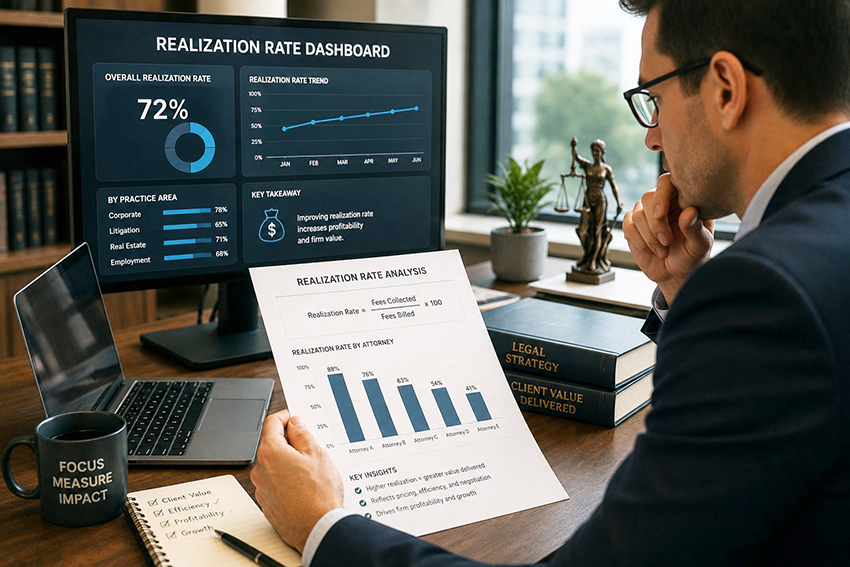
Confessions of a Legal Recruiter: Using the realization rate to gauge an attorney’s value to a firm
Confessions of a Legal Recruiter: Using the realization rate to gauge an attorney’s value to a firm By Shari Davidson [...]
A professional development blueprint for young lawyers
Attorneys should try adding something new to their repertoire of legal skills in each of their first 10 years on [...]
Make every word count in an email subject line
These suggestions – learned from mentors and years of trial and error – are worth considering when you send emails [...]
You may be comparing yourself to the wrong lawyers
Attorneys can often narrow their real competition to a few rivals. They don’t need to be the best lawyer against [...]